Richard Bullmer
The Woman in Cabin 10Richard Bullmer is the owner and public figurehead of the Aurora, a young British peer whose cultivated charm and business authority make him appear to embody the ship’s promise of effortless luxury. His decisive significance lies in the reversal of that promise. The man who presents the Aurora as a “home away from home” is eventually identified as the architect of the deception surrounding Cabin 10, Anne Bullmer’s death, and Laura Blacklock’s confinement. His authority is not merely social decoration: it gives him access to the ship, its staff, its guests, and the mechanisms by which evidence can be controlled.
Identity and Background
Richard is only a few years older than Laura, yet his curriculum vitae initially makes her feel “hopelessly inadequate.” His business history consists of companies and directorships that signal accumulated money and influence, while his public image combines a bronzed appearance, black hair, and a beautiful wife. He is introduced through an account of his wedding to Anne Bullmer, the Lyngstad heiress, whose family owned a major car manufacturer. The marriage therefore places Richard at the intersection of inherited wealth, aristocratic title, and modern corporate power, even though his own history is more complicated than simple privilege.
His early life contains a striking reversal. He attended prep school, Eton, and Balliol, but his father died during Richard’s first year at university, and the family estate was consumed by death duty and debts. With his mother apparently absent, Richard became homeless and alone at nineteen. He nevertheless completed his Oxford degree and founded a dot-com start-up in his third year. Its 2003 flotation began a succession of successes that culminated in the ten-cabin cruise liner conceived as a super-luxury retreat along the Scandinavian coastline. The contrast between destitution and empire helps explain the force of his self-presentation: Richard appears not simply to have inherited power, but to have rebuilt himself through determination, calculation, and an exceptional ability to turn opportunity into control.
Public Authority and Performance
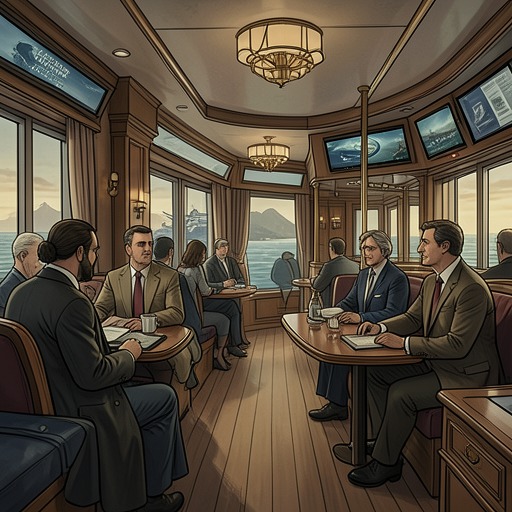
The Aurora is both Richard’s business venture and his stage. Its press material markets the vessel for dream weddings, corporate events, and exclusive family holidays, and Richard presents himself as the person responsible for making that promise credible. At the maiden voyage reception, he introduces himself as the owner alongside Anne and says that the ship is intended to be nothing less than a “home away from home.” He adds that travel should not require compromise and invites guests to bring complaints directly to him, using a warm voice and a lightly inclusive gesture toward Camilla Lidman that makes managerial authority look like personal attentiveness.
His physical appearance reinforces the performance. Richard is tall and wiry, dressed in a precisely tailored suit, fiercely tanned, and marked by bright blue eyes and premature gray at the temples. He laughs expansively among his associates, moves easily despite the ship’s roll, and seems physically fit beneath the elegance of his clothes. When he approaches Laura after Cole Lederer’s candid photograph causes her to spill coffee, he does so with the relaxed assurance of a man accustomed to entering any social space without resistance. Later, at the upper-deck Jacuzzi, he greets her heartily, extends a tanned and muscular arm, and tells her to call him Richard rather than Lord Bullmer. The informality is carefully useful: it lowers the visible barrier between proprietor and guest while preserving the power of the proprietor.
Richard’s social position also depends on the expectations attached to it. Tina West identifies him as the owner and company figurehead, while Laura recognizes the oddity of someone near her own age already being a peer. His wealth is associated chiefly with Anne’s family, but his title, corporate interests, and manner allow him to occupy the role of self-made authority. He is therefore a hybrid public figure: aristocrat, entrepreneur, host, and celebrity businessman. The Aurora’s luxury depends on precisely this fusion, presenting hierarchy as service and command as hospitality.
Control of Laura’s Account
When Laura witnesses the suspected Cabin 10 incident and seeks an explanation, Ben Howard advises her to go directly to Richard, arguing that the owner is where responsibility ultimately stops. Richard’s response initially confirms that expectation. He conducts a prolonged interrogation of Laura’s account, asking about times, durations, sounds, appearances, and the exact shape of blood on the glass screen. He distinguishes smeared blood from sprayed blood and refuses to fill uncertain gaps with speculation or lead her toward a preferred answer. His attention is absolute, his face emotionless, and the polished social tone disappears into a distinctly businesslike manner.
This scene gives his competence a double meaning. Richard appears to be an unusually disciplined investigator, capable of extracting precise information without contaminating a witness’s memory. Yet the same skill can serve concealment as easily as truth. His questions establish that he understands how evidence is formed, how recollection can be narrowed to particulars, and how a witness can be made to feel that the person examining her is the only adult in the room. When Laura explains that she had already been burgled and attacked in her flat before boarding, and that Johann Nilsson made her feel she might have overreacted, Richard takes her hand in a viselike grip and says he is deeply ashamed that a staff member made her feel that way. He assures her that he takes her account with the utmost seriousness.
For Laura, the moment is powerful because someone finally appears to believe her, and Richard’s ownership of the ship makes that belief seem operational rather than merely sympathetic. If anyone can resolve the matter, she thinks, it is him. The scene consequently establishes the central danger of his character: Richard does not need to dismiss Laura openly. He can gain influence by appearing more rigorous, more attentive, and more protective than the people around her. His authority works most effectively when it is experienced as relief.
Conspiracy and Relationships
Laura eventually concludes that Richard is the man most capable of planning and carrying out a murder. Her suspicion arises not from a single visible act but from the convergence of ownership, access, knowledge, and motive. She realizes that the woman in Cabin 10 must have been smuggled aboard before the other guests arrived and that Richard arranged the hidden passenger’s presence. The cabin contained signs of preparation: a silk robe, cosmetics, and hair-removal products indicating that the woman was preparing to impersonate Anne, who was known to have cancer. Richard’s instruction that Cole not photograph Anne suddenly acquires a criminal purpose. It was not simply consideration for Anne’s appearance; it prevented compromising images from exposing the substitution.
Carrie’s confession confirms the structure of the plot. She had agreed to impersonate Anne so that she could remain with Richard, cutting her hair and preparing to pass as his wife. On the first night, Richard told Carrie that Anne had discovered their affair and had attacked him. He claimed that he pushed Anne away defensively, causing her to fall and strike her head on a coffee table, and that she died when he tried to revive her. He then persuaded Carrie to help throw Anne’s body overboard and continue the impersonation, insisting that a police investigation would expose both the affair and Carrie’s presence on board. His account makes Carrie appear an accomplice, but the circumstances also show how Richard turns fear and romantic dependence into obedience.
Richard’s manipulation extends beyond Carrie. He uses the existence of Cole’s photograph, the ship’s enclosed social world, and the possibility of prosecution to make concealment seem like Carrie’s only practical choice. The plan depends on strangers failing to remember Anne’s face, on the absence of photographs, and on the ship’s movement between jurisdictions. Richard’s power is therefore logistical as well as emotional: he arranges cabins, controls information, and relies on the floating environment to delay scrutiny. Laura’s later reflection on willful blindness also exposes the moral atmosphere his scheme creates. People can persuade themselves that they are merely following instructions when the person giving them has made obedience appear safer than resistance.
Exposure and Death
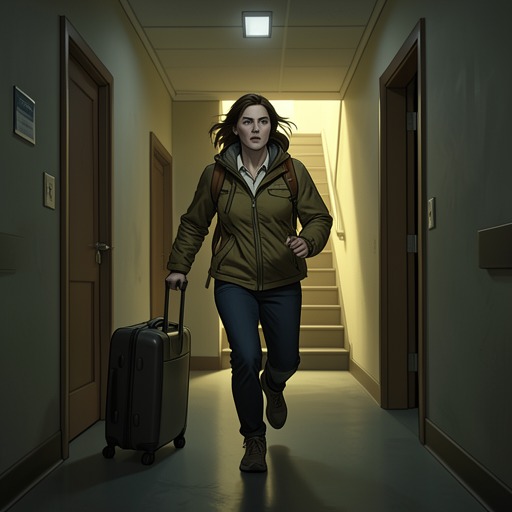
Richard’s position collapses when Laura escapes the hidden cabin and reaches a place where the events can be reported. During the escape, Carrie warns Laura that Richard has her passport, possesses influential contacts in business, and knows people high in the Norwegian police force. Carrie insists that Laura must get away from the coast, cross into Sweden, and avoid flying directly to London because Richard will expect it. Whether every part of that warning is verified or not, it conveys the practical reach attributed to him: even after Laura leaves his immediate custody, he remains able to shape the routes available to her.
Richard is then reported missing from the Aurora, his luxury yacht, off the coast of Norway. An embassy official tells Laura that divers recovered a man who had been shot through the temple, apparently in a possible self-inflicted wound, and that the authorities presume the body to be Richard Bullmer because he had been reported missing by the crew. A second body, a very slim woman with shorn hair, is found drowned. The paired discoveries transform the earlier disguise into physical evidence: the woman’s altered hair points toward Carrie’s role, while Richard’s presumed death closes the immediate circle of the conspiracy without making its moral consequences disappear.
The later news report gives Richard one final public image. Laura sees his face on television and momentarily thinks she is hallucinating before realizing that the broadcast is reporting his death. The report identifies him as a British businessman and peer, majority shareholder in the troubled Northern Lights Group, found dead after disappearing from the Aurora off the Norwegian coast. Even in death, the media presents the public Richard: businessman, peer, shareholder, and owner of a luxury yacht. The private history of coercion and murder must be read against that polished image, because the same social identity that made him newsworthy also helped him appear trustworthy.
Narrative Role and Significance
Richard functions as the novel’s shadow behind the Aurora’s promise of safety. He is a threshold guardian in inverted form: instead of protecting passage into a new world, he controls movement through a closed one, deciding who may enter cabins, whose identity may be displayed, and which account will be treated as credible. His apparent competence initially resembles a solution to Laura’s crisis, but the plot gradually reveals that the person best equipped to investigate the ship is also the person best equipped to manipulate its evidence.
His character joins class power to practical intelligence. Aristocratic title, corporate success, physical confidence, and polished hospitality do not operate separately; together they produce an authority that can be mistaken for moral reliability. Richard’s rise from homelessness to business prominence makes him more than a flat symbol of inherited privilege, because the text acknowledges his discipline and achievement even as it exposes the violence concealed beneath them. That complexity sharpens the indictment. His crimes are not caused by incompetence or social marginality, but are enabled by the very qualities that make him impressive.
The “home away from home” becomes the governing irony of his role. Under Richard’s direction, the Aurora offers luxury as insulation from ordinary consequences, yet its enclosed cabins, restricted information, and movement across the North Sea turn hospitality into confinement. Richard’s final disappearance does not simply remove a villain; it reveals the cost of a world in which wealth can make coercion look like service, secrecy look like discretion, and a frightened witness feel grateful to the person who is examining her.